Market Bias
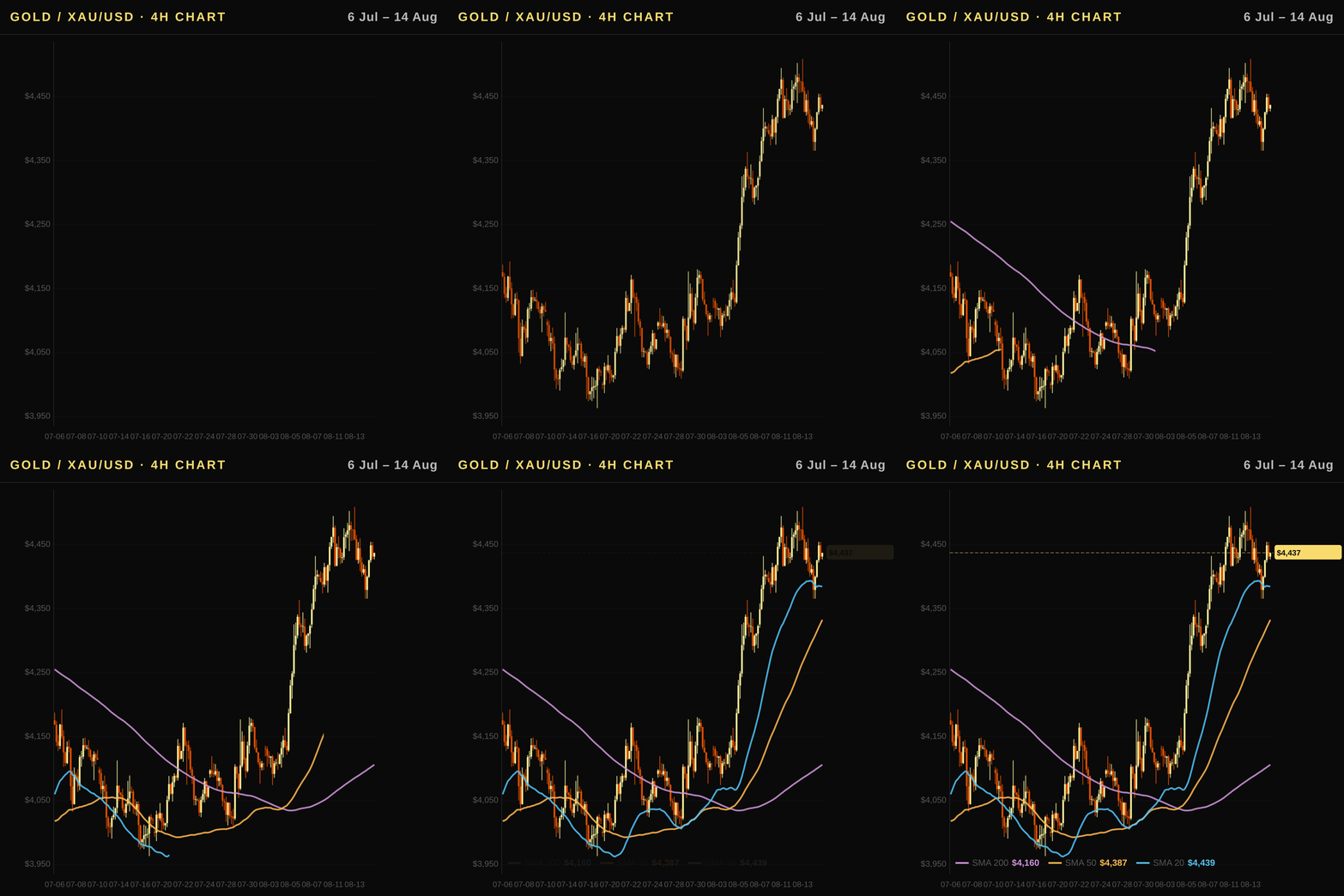
Bullish. Gold has rallied 2.23% in a week and now trades above both the SMA 20 ($4177.5) and the SMA 50 ($4150.1), with only the SMA 200 ($4494.7) still overhead. The MACD histogram at 39.54 and a line at 74.41 above its 34.87 signal confirm upward momentum. Real rates near the Fed’s TIPS yield of 2.39% keep opportunity costs elevated for this non-yielding asset, but a US Dollar Index (DXY) down -1.05% on the month is supportive of global demand.
Executive Summary
The gold price today in Canada is trading at CAD 6,156/oz, reflecting a robust weekly gain of 2.23% as XAU/USD analysis highlights strong momentum despite elevated yields. In USD terms, the metal commands $4,437.30/oz following an impressive monthly surge that underscores its appeal as a non-yielding asset during periods of geopolitical uncertainty. This gold price today reading is supported by significant ETF inflows totaling nearly $2.97 billion over the month and rising central bank demand for physical holdings globally. While real rates remain positive, the combination of speculative bullish positioning in futures contracts and persistent safe-haven flows suggests that further upside potential exists before testing key resistance levels near $4,591. Canadian investors should monitor the Bank of Canada’s independent policy stance relative to US Fed decisions, as rate differentials continue to influence both the loonie and domestic gold valuations.
Canada Outlook: BoC Policy, the Loonie, and Gold in CAD
- Canadian investors buy gold priced in CAD, meaning a weaker local currency boosts domestic prices while a stronger loonie compresses them; with the USD/CAD rate at 1.3874 and stable over thirty days despite a -1.17% monthly shift, current US levels translate to approximately 6,156 CAD per ounce.
- As a commodity-linked currency, the loonie often tracks global risk sentiment and oil prices; WTI crude has rallied sharply this week (+5.4%) and month-over-month (+4.37%), providing fundamental support for the local dollar even as broader equity volatility remains muted with the VIX down -14.82% over the same period.
- The Bank of Canada maintains a policy rate at 2.25%, holding steady while tracking its 2% inflation target which currently sits near consensus; this creates an independent monetary stance distinct from US Fed movements, though the BoC–Fed differential remains a primary driver for USD/CAD exchange rates.
- Domestic economic data reflects resilient growth with GDP expanding by 1.7% in 2025 and annual CPI registering at just above 2%, suggesting stable conditions that allow Canadian bullion investors to focus on FX-driven gold price mechanics rather than domestic recession fears or rapid rate cuts.
Technical Analysis
XAU/USD analysis reveals a recovering structure where price action holds well above its 20- and 50-day moving averages, though still under the 200-day, despite broader macro headwinds from elevated real rates. The current spot gold of $4,437.3 trades comfortably below the 60-day resistance at $4,591.8 but sits just beneath the upper Bollinger Band channel near $4,473.3. Price has cleared the middle band (SMA 20) and SMA 50, both acting as dynamic support in this rally.
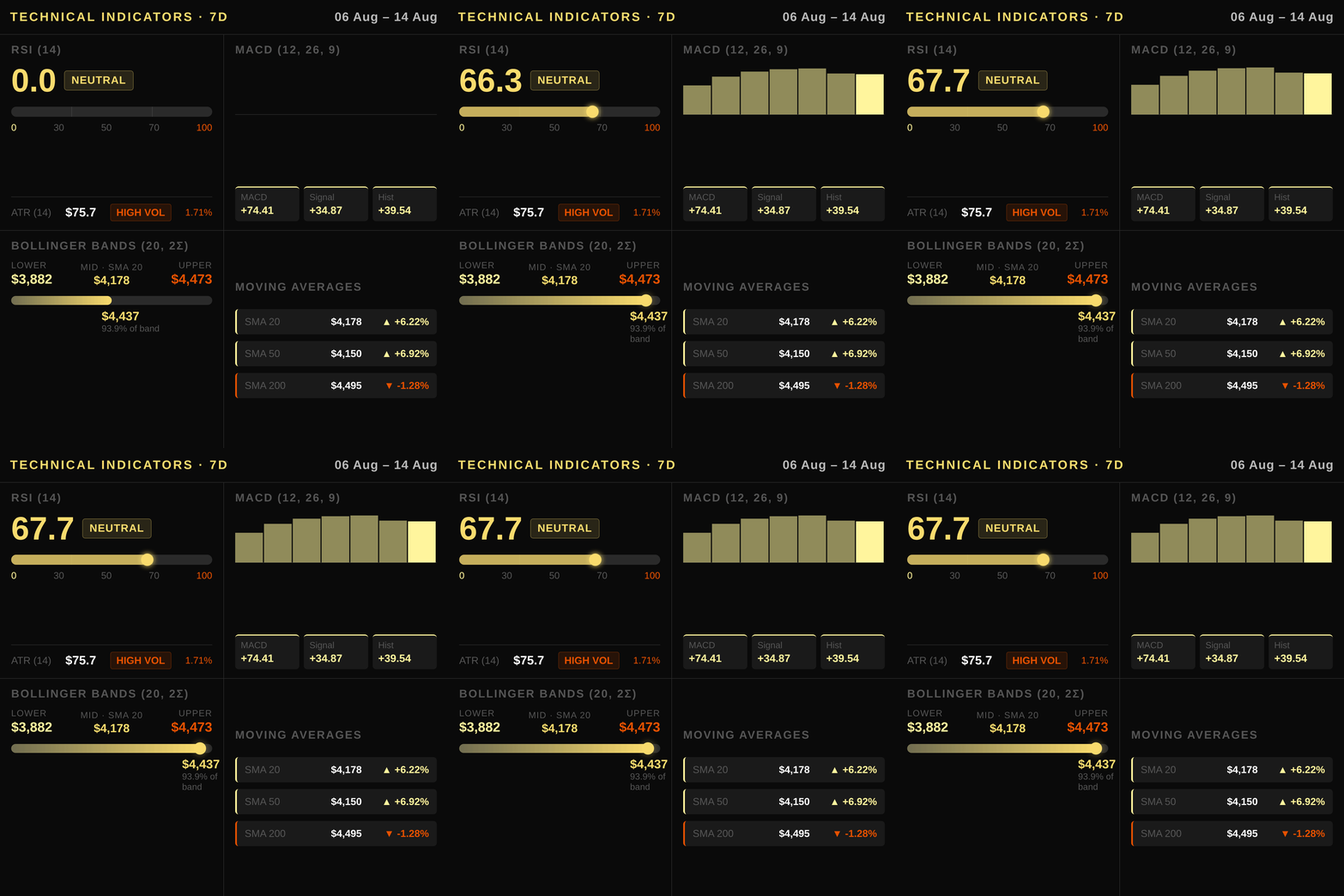
The RSI stands at 67.7, indicating strong bullish momentum that is approaching overbought territory without yet triggering a sell signal; oscillators remain elevated above the neutral level of 50. The MACD histogram shows a reading of 39.54, while the line sits significantly higher than its signal component, confirming sustained upward pressure, even though the longer-term structure defined by the 200-day average has yet to turn.
Volatility remains contained with an Average True Range (ATR) at 75.7 points per ounce, suggesting that breakouts or breakdowns from current Bollinger Bands could trigger sharp moves in the immediate session. Canadian investors watching these USD levels should note how support near $4,177.5 translates to roughly CAD 5,800 and resistance above $4,494.7 corresponds to approximately CAD 6,239 on local charts today.
Macroeconomic Factors
The Federal Reserve maintains a funds rate of 3.63%, while the market prices in further cuts as yields decline, creating conditions that pressure real rates and support gold’s non-yielding asset appeal. Although the nominal US 10Y Treasury yield has risen to 4.6% this week, the critical metric for investors is the TIPS-based real rate of 2.39%, which remains elevated but saw a slight decline recently as price sensitivity increased. A stronger dollar index at 99.67 presents an inverse relationship challenge to gold pricing globally, yet recent weakness in other sectors suggests potential room for DXY rotation back toward precious metals demand from abroad. Geopolitical tensions continue to supply the risk-off premium that often outweighs the drag of higher real interest rates during periods of acute uncertainty or market stress events.
Positioning and Market Flows
The CFTC Commitment of Traders report for gold futures shows a robust non-commercial net long position of 217,940 contracts, with speculative positioning rising by 31,258 contracts over the past week. This accumulating bullish stance from large institutional speculators aligns with the broader market sentiment despite the asset trading below its all-time high near $5,600 USD/oz.
Institutional flows via exchange-traded funds reinforce the signal from futures positioning. Gold ETF holdings increased by 23.5 tonnes in July, reflecting net inflows of approximately $2.97 billion. These positive flows indicate sustained demand for the metal from investors seeking portfolio diversification and protection against currency debasement or geopolitical instability.
Central bank buying continues to underpin long-term price support as major economies add gold reserves to their balance sheets, insulating them from external sanctions risks. While private sector positioning fluctuates with short-term volatility, this structural demand ensures that deep liquidation events are unlikely unless a significant macro regime shift occurs in global monetary policy or risk appetites.
Correlated Assets
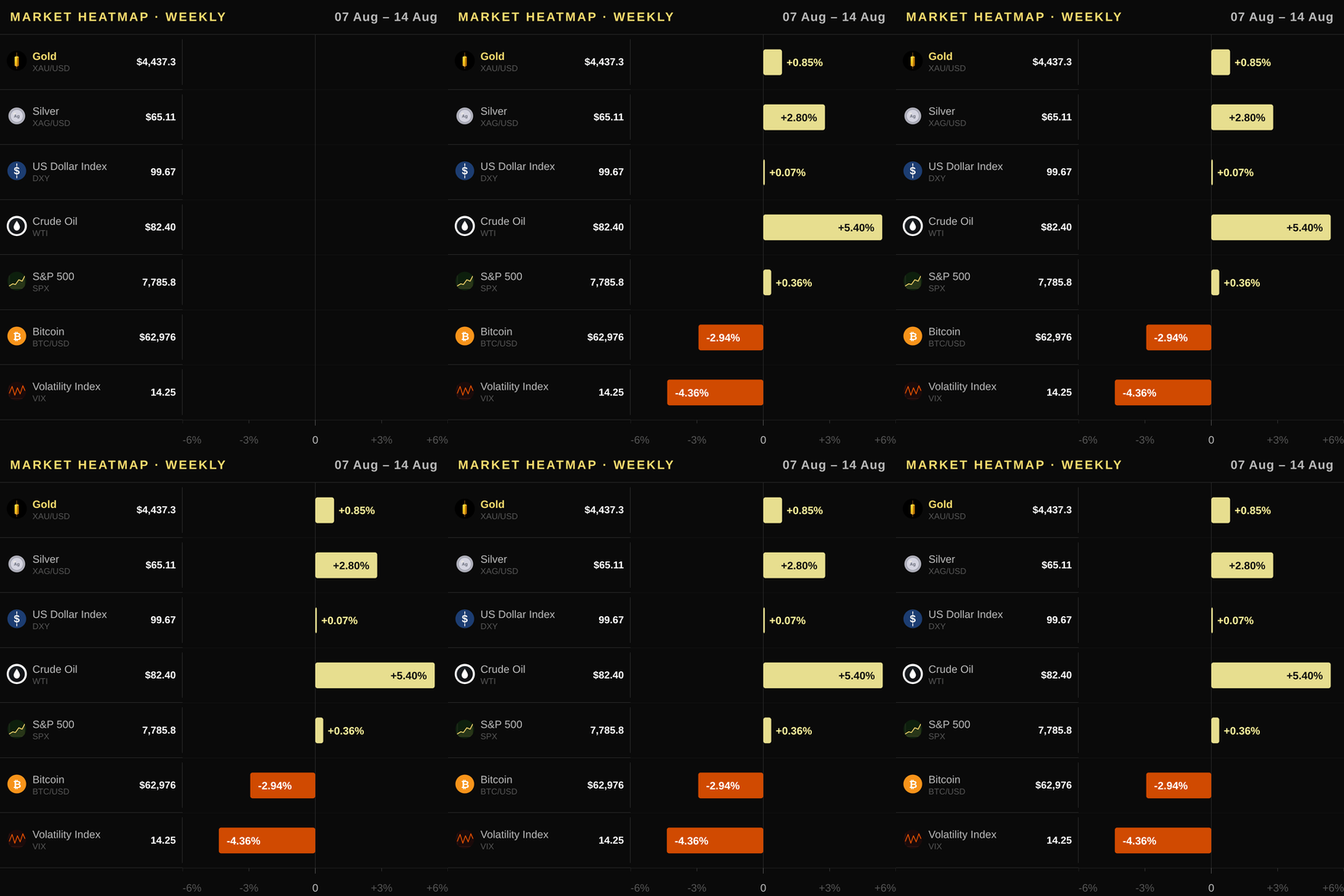
Silver advanced 2.8% this week to $65.10/oz, reinforcing gold’s bullish technical structure as industrial demand remains robust alongside safe-haven flows. Copper futures rose another 0.65% on the weekly chart despite a broader market slowdown, signaling sustained infrastructure investment and supply constraints that support precious metals valuations. WTI oil climbed to $82.4/barrel with a strong +5.4% gain this week, providing direct tailwinds for the loonie while keeping commodity-linked currencies buoyant against USD headwinds. The US Dollar Index (DXY) sits at 99.67, essentially flat on the week at +0.07% but down -1.05% over the month, reducing purchase costs for foreign investors and creating favorable conditions for gold’s global demand expansion. The 10Y-2Y spread widened slightly to 0.51% and the 10-year yield rose to 4.6%, keeping opportunity costs firm; gold's appeal here rests on the softer dollar and safe-haven demand rather than on falling yields. The S&P 500 posted modest weekly gains of +0.36% while volatility measures remain subdued with the VIX down -4.36%, suggesting that equity market stability does not contradict gold’s safe-haven appeal during periods of geopolitical uncertainty or fiscal policy shifts.
Upcoming Catalysts
- US Gross Domestic Product — 2026-08-26: A stronger-than-expected reading could fuel higher real rates, while a miss might support gold by easing expectations for further rate hikes.
- US Non-Farm Payrolls — 2026-09-04: Robust job growth would tighten labor markets and increase inflation pressure, whereas weaker hiring data could prompt the Fed to pause or cut policy sooner.
- US Producer Price Index — 2026-09-10: Rising wholesale prices signal persistent cost-push inflation that keeps real rates elevated and weighs on gold demand from non-yielding investors.
- US Consumer Price Index — 2026-09-11: Accelerated consumer spending growth reinforces the case for a hawkish Fed, which typically pressures the USD upward but may also boost safe-haven flows if inflation fears spike unexpectedly.
Trading Idea
Given price is holding above its near-term moving averages with positive momentum, traders should look for a long position on XAU/USD with an entry zone between USD 4,350 and USD 4,440 (CAD 6,035–6,160). A stop loss is placed at USD 4,140 (CAD 5,744), just below the SMA 50, to invalidate the setup if that support fails. The target price sits at USD 4,590 (CAD 6,368), the 60-day high, with the SMA 200 at USD 4,494.7 the intermediate level to clear. Canadian investors can execute this strategy using physical gold via Royal Canadian Mint bars or Maple Leaf coins, or by utilizing TSX-listed instruments like the iShares Gold Bullion ETF (CGL.TO) or Sprott Physical Gold Trust (PHYS).
Price Outlook and FAQ
The expected range for gold tomorrow is USD $4370–$4506 (CAD 6,068–6,251), reflecting consolidation near current levels before testing resistance at the USD 4,591.8 mark. Next week's directional bias remains constructive while price holds above the SMA 20, with the SMA 200 the level still to be cleared.
Is gold a good inflation hedge for Canadian investors given current US and domestic CPI? While US CPI sits at 3.54%, which outpaces Canada’s annual rate of 2.1% in nominal terms, real rates remain high because the 10Y Real Rate (TIPS) is 2.39%; this elevated opportunity cost limits gold's effectiveness as a pure inflation hedge unless central banks cut policy rates or geopolitical risks escalate to force safe-haven flows that override yield pressures on non-yielding assets like bullion.
How do Bank of Canada and Fed rate decisions impact gold prices in CAD? Gold pricing in CAD is driven by two main channels: the USD/CAD exchange rate, which strengthens (making local gold cheaper) when BoC rates track higher than the 3.63% Fed Funds Rate due to persistent inflation differentials; conversely, a weaker loonie from rising commodity prices pushes up local bullion values regardless of global dollar-denominated trends.
How can Canadian investors buy physical or ETF gold? Canadian households can access exposure via the iShares Gold Bullion ETF (CGL.TO) and Sprott Physical Gold Trust (PHYS), both listed on the TSX, which track spot prices without storage hassles; alternatively, retail buyers may purchase Royal Canadian Mint bars or Maple Leaf coins from licensed bullion dealers to hold physical metal in their own vaults.
This article is for informational purposes only and does not constitute investment advice or a financial recommendation. Investing in financial assets involves risk.
Key Takeaways for Traders
- Market Stance: The XAU/USD market is Bullish as price holds above the SMA 20 and SMA 50 with a positive MACD histogram, though the SMA 200 at USD 4,494.7 remains overhead resistance; traders should view dips toward those short-term averages as potential long entry points.
- Key Technical Level: Monitor the USD 60-day high of $4,591.8 and its CAD equivalent near CAD 6,371 as primary resistance that must be breached to invalidate the current downtrend structure in gold analysis today.
- Macro Driver: Watch US CPI data scheduled for September alongside rising real yields on TIPS at 2.39% which increase the opportunity cost of holding non-yielding bullion and pressure XAU/USD lower.
- Sentiment Signal: Institutional ETF inflows totaling $2,965 million this month suggest a structural demand floor that may limit downside severity even if speculative positioning remains net long on futures contracts per COT data.
- Risk Consideration: A sudden spike in the US Dollar Index (DXY) or geopolitical escalation could trigger rapid volatility spikes; Canadian investors should ensure adequate portfolio diversification when deploying capital into physical Royal Canadian Mint bars versus liquid ETF shares like iShares Gold Bullion (CGL.TO).