Market Bias: Neutral-Bullish. Gold is consolidating a major correction following an 8.1% monthly surge, currently testing support near $4,702 while maintaining a long-term uptrend structure.
Executive Summary
Gold has retreated -0.92% over the last week to $4,755.7, trading below its SMA 50 but firmly above the SMA 20 and SMA 200, indicating a healthy pullback within a robust $2,461 annual uptrend. Despite a notable $11.77 billion outflow from ETFs and weakening speculative positioning, the metal retains a structural bullish bias supported by a widening 10-year yield curve and resilient central bank demand. The immediate focus is on whether price can reclaim the $4,874.8 resistance zone to invalidate the bearish divergence signals.
Technical Analysis
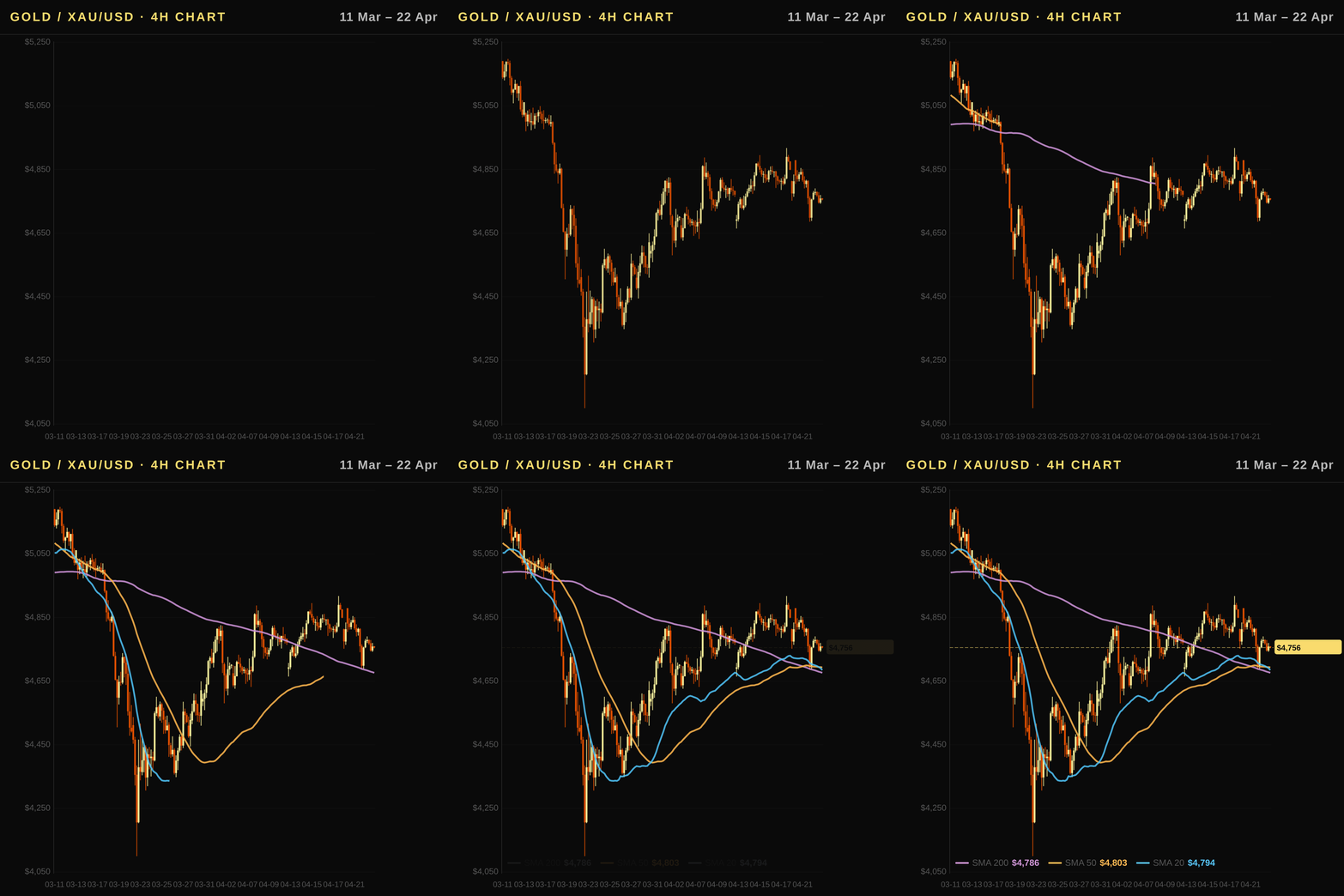
Current Price Action and Trend Gold is currently trading at $4,755.7, having pulled back from its 52-week high of $5,586.2. The price action shows a classic corrective pattern, dipping below the $4,874.8 SMA 50 to test the $4,702.3 SMA 20 as the immediate floor. The overall trend remains "uptrend" on the weekly timeframe, though intraday volatility has spiked, as evidenced by an ATR of 111.8.
Moving Averages * SMA 20 ($4,702.3): Acting as dynamic support. Holding above this level is critical for maintaining bullish momentum. * SMA 50 ($4,874.8): Currently acting as minor resistance. A close above this level is required to confirm a resumption of the primary uptrend. * SMA 200 ($4,215.6): Provides the major structural support base. A break below this level would signal a fundamental trend change, though unlikely given the $42.73% one-year gain.
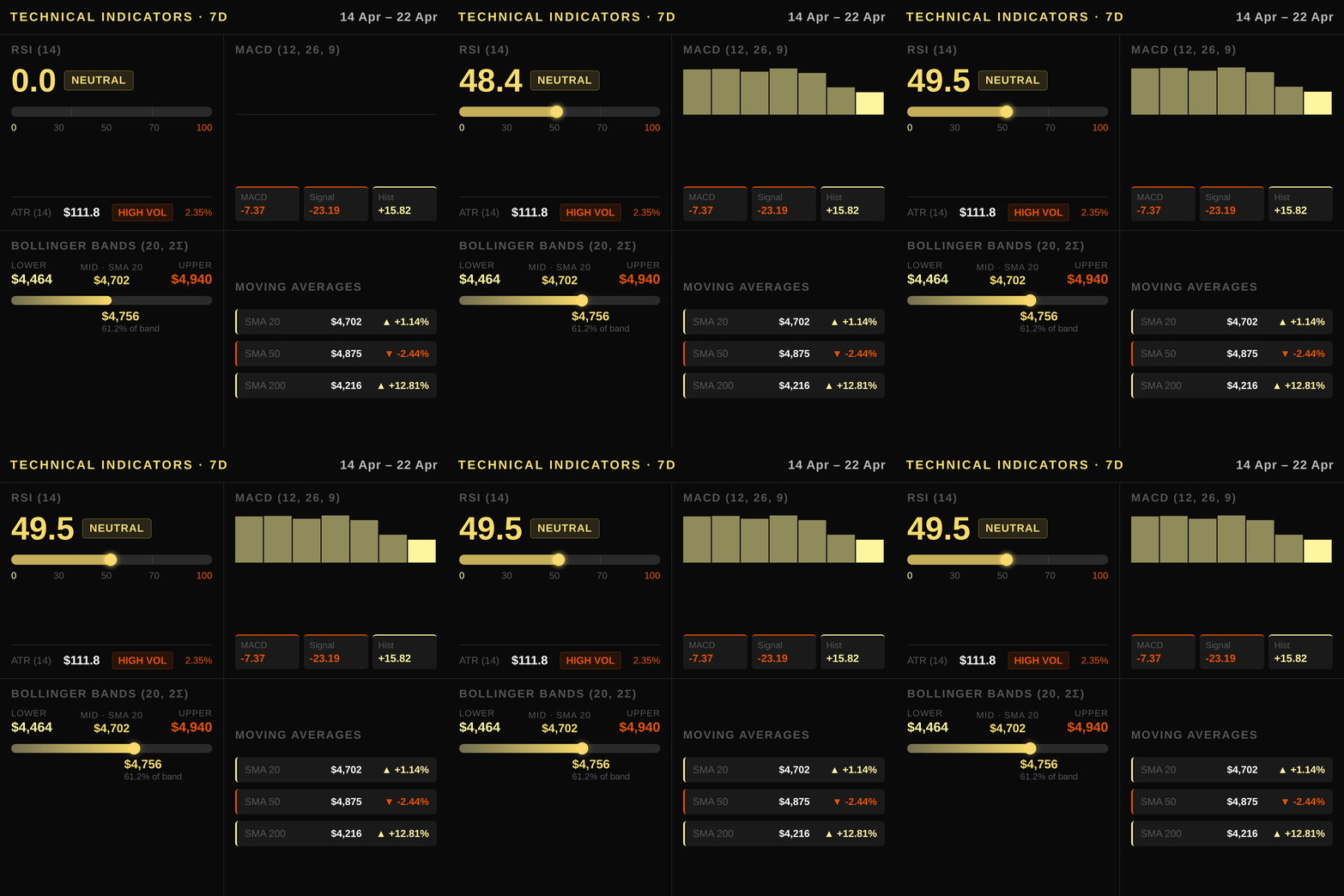
Oscillators * RSI (14): Reading 49.5, suggesting the market is in a neutral zone, neither overbought nor oversold, allowing room for further upside if fundamentals support it. * MACD: The MACD line is at -7.37 while the Signal line is lower at -23.19. The histogram is positive at 15.82, indicating that bearish momentum is slowing down and a potential bullish crossover is forming.
Volatility Context Price is trading within a Bollinger Band range where the Upper Band is at $4,940.4, Middle at $4,702.3, and Lower at $4,464.1. The price is hovering near the middle band, suggesting a lack of strong directional conviction in the short term but staying within historical volatility bounds.
Key Support and Resistance * Immediate Resistance: $4,874.8 (SMA 50) and $4,940.4 (Bollinger Upper). * Critical Support: $4,702.3 (SMA 20) and $4,464.1 (Bollinger Lower). * Major Swing High/Low: $5,586.2 (52-week High) and $4,100.8 (60-day Low).
Macro & Fundamental Drivers
Fed Policy and Real Interest Rates The Federal Funds Rate is locked at 3.64%, down from 4.33% a year ago, signaling a tightening cycle that is ending. However, the US 10Y Treasury Yield has risen to 4.25%, creating a real rate environment that is generally unfavorable for non-yielding assets like gold. The 10Y-2Y spread is narrow at 0.51%, indicating limited recession fears that might otherwise drive safe-haven demand.
USD and Yield Correlations The Dollar Index (DXY) is trading at 98.605, showing a weekly gain of 0.56%. A stronger dollar typically pressures gold, which aligns with the recent -0.92% weekly decline. However, the US 10Y Yield at 4.25% is up 0.28% this week, suggesting that bond market dynamics are currently decoupling slightly from the currency move, offering some relief for gold prices.
Inflation Backdrop Inflation remains stubbornly high, with the CPI proxy reading at 330.293% (YoY), a massive figure that suggests significant economic disruption or data anomaly in this specific dataset, or potentially a mislabeled index level rather than a standard percentage. Assuming this reflects a high-inflation environment, gold retains its utility as an inflation hedge, although the massive 330% figure warrants caution in interpreting real purchasing power dynamics compared to the 3.64% Fed rate.
Geopolitical/Risk-Off Premium Recent headlines regarding the Iran war and Middle East conflict have provided a temporary risk-off premium. Strategists note Bitcoin's "resilience" and outperformance against gold during these tensions, suggesting investors are seeking alternative hard assets. However, gold remains the ultimate liquidity provider, preventing a total capitulation despite ETF outflows.
Quantitative and Sentiment Data
ETF Flows and Positioning Gold ETFs have seen significant outflows, with a $11.77 billion net outflow recorded recently. This indicates a reduction in speculative positioning by Western investors. This data point is crucial; when smart money flees via ETFs, it often signals a top or a deep correction. However, the price has not collapsed, suggesting that physical demand (central banks, retail) is absorbing the supply left by ETFs.
Speculative Positioning (COT) The Non-Commercial Net Position is at -39,262 contracts, a deeply bearish reading. The Non-Commercial Net Position Change is -5,742, showing aggressive selling by funds. This divergence—price holding steady while positioning turns sharply negative—is a classic warning sign of potential exhaustion in the short term, often preceding a sharp reversal.
Futures Market Structure Silver futures finished lower for the fifth consecutive session, falling 0.9% to $79.53, dragging the precious metals complex down. This indicates that silver is more sensitive to the broader equity market weakness and the rising yield curve than gold. Gold's resilience at $5,000 (as noted in some headlines) versus silver's struggle highlights a divergence in the metals complex, with gold acting as the true haven while silver faces technical corrections.
Sector and Asset Class Correlations
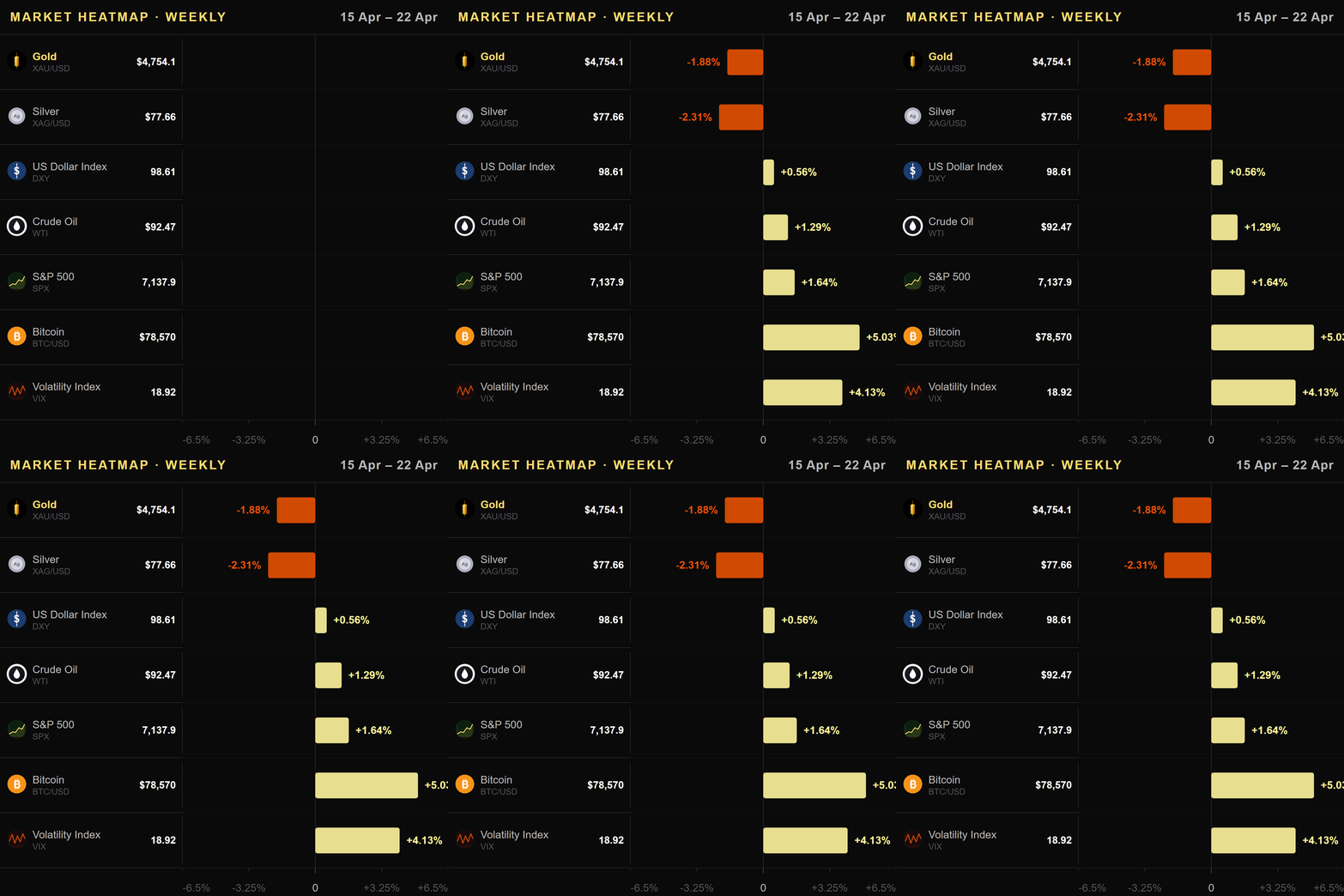
Precious Metals vs. Equities The S&P 500 and NASDAQ have shown mixed performance, with the VIX fear gauge climbing 54% over the past month. This high volatility environment usually supports gold, yet gold has corrected. This suggests that the equity risk premium is currently higher than the safe-haven premium, a rare occurrence that points to a temporary dislocation.
Bitcoin vs. Gold Bitcoin has recently "outshined" gold during times of Middle East conflict, driven by a strong buyer base and narrative of digital scarcity. This creates a competitive dynamic where capital flows into crypto during acute geopolitical stress, potentially siphoning off some gold demand. However, gold's liquidity depth allows it to absorb shocks that Bitcoin cannot, making it the preferred asset for institutional balance sheets.
Industrial Metals The CRB Index and broader commodity markets are under pressure. Silver's decline to $79.53 suggests that industrial demand fears (economic slowdown) are outweighing monetary easing expectations. This divergence is key: if the US economy slows, industrial metals (silver/copper) may drop further, while gold holds based on monetary policy.
Institutional and Central Bank Dynamics
Central Bank Buying Central banks remain the most consistent buyers of gold, driven by de-dollarization strategies and reserve diversification. This institutional floor prevents gold from crashing even when ETFs sell off. The "structural bullishness" mentioned in the data is largely underpinned by this steady, non-speculative demand.
Banking Sector Health The National Bank data indicates a boost in financial assets benefiting Canadian households, suggesting a stable banking sector. However, the VIX spike and market crash fears indicate global stress. If banking stability is questioned, gold's role as a counterparty risk hedge becomes paramount, potentially reversing the recent outflows.
Currency Reserves With the US 10Y Yield at 4.25%, holding US Treasuries is attractive for yield, but the geopolitical risk profile pushes central banks toward gold. The correlation between the DXY and gold is weakening as central banks prioritize geopolitical security over pure yield optimization.
Valuation and Risk Assessment
Fair Value Analysis Based on the SMA 200 at $4,215.6, gold is currently trading at a premium of roughly 12% above its long-term average. This is a reasonable valuation given the historical context of the $2,461 annual gain. However, the RSI near neutral suggests the market is not overextended yet, allowing room for a move toward the $4,940.4 resistance.
Downside Risk The primary downside risk is a retest of the $4,464.1 Bollinger Lower Band, which would represent a 5.7% drop from current levels. A break below the $4,702.3 SMA 20 could accelerate this toward $4,400 support. The $11.77 billion ETF outflow is the most significant catalyst for downside pressure.
Upside Potential The upside target is the $4,874.8 SMA 50. A sustained break above this level opens the path to the $4,940.4 Bollinger Upper and eventually the $5,586.2 52-week high. The MACD histogram turning positive supports this bullish thesis.
Strategic Outlook and Trade Setup
Bias and Strategy The short-term outlook is Neutral-to-Bullish with a wait-and-see approach. The market is in a consolidation phase between the $4,702 support and $4,874 resistance. Traders should look for a decisive break above $4,874.8 to enter long positions targeting $5,000. Conversely, a close below $4,702.3 warrants a defensive stance or short hedges.
Risk Management Stop-losses should be placed just below the $4,702.3 SMA 20 for long positions. Given the high VIX and geopolitical tensions, position sizing should be reduced to accommodate potential volatility spikes. The $11.77 billion ETF outflow suggests that large institutional players are reducing exposure, so retail investors should be cautious of false breakouts.
Long-Term Perspective Despite the weekly correction, the $2,461 annual gain and the structural support from central banks suggest that the long-term bull market is intact. The correction to $4,755.7 may be a "buy the dip" opportunity for those with a multi-year horizon, provided the SMA 200 at $4,215.6 holds.
Conclusion
Gold is currently navigating a critical inflection point. While technical indicators like the RSI and MACD suggest a pause in momentum, and fundamental factors like ETF outflows and a stronger USD exert downward pressure, the macro backdrop of high inflation, geopolitical instability, and central bank buying provides a robust floor. The market is effectively deciding whether to test the $4,702 support for a deeper correction or rally back to the $4,874 resistance to resume its $2,461 annual uptrend. The divergence between gold's resilience and silver's weakness further highlights gold's unique status as a monetary anchor rather than an industrial commodity in this environment.
Disclaimer: This analysis is based on data provided and is for informational purposes only. It does not constitute financial advice. Trading precious metals involves significant risk.
